The Room Speaks Softly: A Birmingham Guest’s Guide to Ten Tea Terms
A first tea gathering in Birmingham need not feel like an examination in another language. The room is quiet, the utensils are few, and the conversation — such as it is — tends to circle a small set of words. Learning ten of them is not a party trick. It is a form of consideration: a way of following the host’s hand, understanding what is being offered, and settling more quickly into the rhythm of the occasion.
Japanese tea terminology can look forbidding on the page, but most of the words a guest actually hears are short and serviceable. They name the bowl, the whisk, the cloth, the kettle. They describe what is happening rather than demanding a response. The notes below are intended as a quiet companion, not a glossary to be recited at the threshold.
First, a Word About Saying Them
English speakers in the Midlands tend to stress Japanese words too heavily and lengthen the vowels. A lighter touch is usually better. Keep the vowels short and clean, avoid a dramatic rise and fall, and let the word sit at the same volume as the rest of the sentence. Pronunciation guides are approximations at best; a host will not expect perfection, and nobody in a Birmingham tea room is likely to correct a guest mid-bowl.
It also helps to remember that these words are not passwords. Using one correctly is less important than using it sparingly and with attention. A guest who says nothing but watches carefully is rarely thought ill of.
The Bowl and the Tools
Chawan — the tea bowl
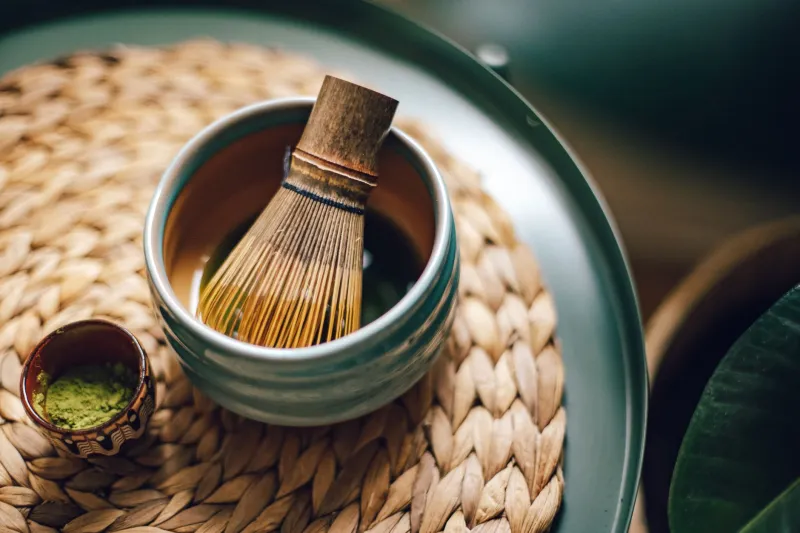
Said roughly chah-wan, with a flat first vowel. The chawan is the centre of the gathering: the vessel into which matcha is whisked and from which it is drunk. In a Birmingham room, the bowl may be a modest local piece or a well-travelled ceramic, but its role is constant. When a host presents a chawan, a guest may lift it slightly, turn it, and admire it — not as an appraisal, but as an acknowledgement of the object and the care behind it.
Chasen — the bamboo whisk
Said chah-sen. The chasen is the fine-pronged bamboo whisk used to bring matcha and water together into a smooth, faintly frothy infusion. A guest is not usually asked to handle one, but the word may arise when the host explains the preparation. It is worth knowing that the chasen is delicate: it is rinsed rather than scrubbed, and its tines are easily damaged by force.
Chashaku — the tea scoop
Said chah-sha-koo, with a short final vowel. The chashaku is a slender bamboo scoop, often carved with a subtle curve, used to measure matcha from the container into the bowl. It is one of the smallest utensils in the room and one of the most personal; many hosts treat a favourite chashaku with particular care. A guest need only recognise it as the implement that carries the tea.
The Vessels at the Side
Kensui — the waste-water bowl
Said ken-soo-ee. The kensui is the bowl into which water used to rinse the chawan and chasen is emptied. It sits to the side and is rarely the focus of attention, which is precisely its purpose. Knowing the word helps a guest understand that the small movements near the host’s knee are part of a considered sequence, not an improvisation.
Chakin — the tea cloth
Said chah-kin. The chakin is a small, usually white linen or hemp cloth used to wipe the chawan before and after use. In a Birmingham gathering, it may be folded with great precision. A guest does not need to touch it, but the word often appears when a host describes the order of preparation. The chakin is a reminder that cleanliness in tea is not merely practical; it is part of the welcome.
Hishaku — the water ladle
Said hee-shah-koo. The hishaku is the long-handled bamboo ladle used to transfer hot water from the kettle to the bowl. It is a quiet utensil, but its presence explains much of the host’s movement. When the word is used, it usually refers to the ladle itself rather than to a measured quantity; tea is not cooked by recipe in the ordinary sense.
Cloth, Container, Kettle
Fukusa — the silk cloth
Said foo-koo-sah. The fukusa is a square of silk, often folded and tucked at the host’s waist, used to wipe the tea container and scoop in a formal procedure. It is not a duster, and it is not for the guest’s hands. The word may sound ceremonial, but it refers to a small, ordinary act of care. In a Midlands tea room on a grey November afternoon, the fukusa’s colour can be one of the few warm notes in the room.
Natsume — the tea container
Said naht-soo-meh, with a soft final vowel. The natsume is a lacquered container, usually with a rounded lid, holding the matcha. The word is often used for the vessel in thinner-tea preparation. A guest may be invited to look at it, but should not open it. Its name is useful mainly because it helps distinguish the container from the bowl and the scoop when a host is explaining the arrangement.
Kama — the kettle
Said kah-mah. The kama is the iron kettle, often set over a small charcoal fire or a modern heat source, from which hot water is drawn. In a Birmingham setting, the kama may be the source of the soft, steady sound that fills the room before anyone speaks. The word is simple, and worth knowing: much of the gathering’s timing is set by the kettle rather than by the clock.
The Gathering Itself
Temae — the procedure
Said teh-mah-eh, with each vowel given its place. Temae refers to the sequence of movements by which tea is prepared. It is not a performance in the theatrical sense, and a guest is not an audience. The temae is a shared occasion: the host makes tea, the guest receives it, and the room holds both. Knowing the word can help a first-time visitor understand that the apparent slowness is deliberate, not hesitant.
Using the Words Without Making a Lesson
A little vocabulary goes a long way, and rather less goes further. The point is not to demonstrate knowledge but to reduce the distance between guest and host. If a term is unfamiliar, it is perfectly acceptable to ask quietly afterwards, once the bowl has been returned and the gathering has begun to loosen. A Birmingham host is unlikely to mind a question; they may mind a guest who treats the tea room as a language classroom.
It is also worth remembering that many gatherings proceed with almost no nomenclature at all. The host may simply say “please” and offer the bowl. The words are there when needed, like the utensils themselves: useful, unassuming, and best kept in their proper place. Learn a few, listen for them, and let the rest of the room speak for itself.