The Declined Bowl: Offering Tea Without Insistence in Birmingham
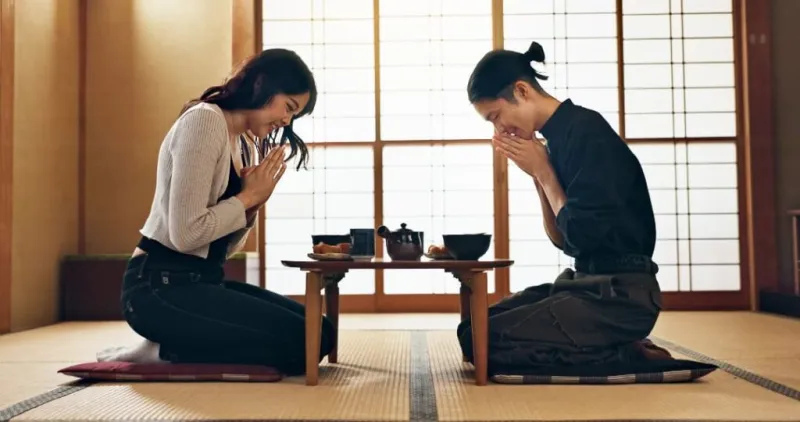
Photo: Japanese roasted barley tea in ceramic cup beside teapot, warm natural light, via www.wapititravel.com
A tea gathering begins long before the first guest crosses the threshold. It begins with a host wondering who will come, and what they will need. In Birmingham, as in any city, those needs are varied: a guest who avoids caffeine after a certain hour, a guest carrying a pregnancy, a guest whose medication does not sit well with strong green tea, a guest who has simply never cared for the taste and is too polite to say so until asked.
The bowl, when it arrives, is an offer rather than an obligation. That distinction is easily lost in the careful choreography of a formal room, where so much appears prescribed. It is worth recovering, because hospitality that cannot accommodate a refusal is not hospitality at all — it is performance.
Asking Before the Day
The most considerate way to handle a declined bowl is to ensure it is rarely declined in the first place. A brief line in the written invitation, or a quiet word when the reply is given, allows a guest to state a preference privately rather than in front of others. Something plain will do: that tea will be served, that a caffeine-free alternative is equally available, and that either choice is entirely welcome.
This is not an intrusive question, provided it is asked once and not pressed. A guest who deflects the enquiry should be left to deflect it. The host's task is to have made the offer possible, not to obtain an answer.
Receiving a Refusal
Should a guest decline at the moment the bowl is presented, the correct response is brief and warm. A small bow, a sentence of acknowledgement, and an immediate move to the alternative. Nothing further is required. There is no place in the room for persuasion, for reassurance that the tea is mild, or for the well-meant insistence that a single sip will do no harm.
Equally, the guest should not be made to feel conspicuous. Avoid the announcement to the room, the sympathetic glance, the hasty rearrangement that draws every eye. The substitution should be made as though it were always part of the plan — which, in a well-prepared gathering, it was.
It helps to keep the vessel consistent. A caffeine-free infusion served in a bowl of comparable scale and warmth reads as participation rather than exemption. The guest is not being managed; they are being served.
Four Suitable Alternatives
Several options are easily found in Birmingham and require no specialist knowledge.
Roasted barley (mugicha). Deeply familiar in Japanese households and increasingly stocked in UK supermarkets, mugicha is naturally caffeine-free and has a nutty, faintly sweet character that suits a cool morning. It can be served hot in autumn and winter, and lightly chilled in summer. Loose barley is available from Japanese grocers such as those around the Arcadian and in Nechells, and bagged versions appear in most large supermarkets.
Kombu tea. Not to be confused with the fermented soft drink that shares a similar name in English, Japanese kombucha is a simple infusion of dried kelp. It is savoury, faintly saline, and warming, and it carries a certain ceremony of its own. Dried kombu is widely sold in health-food shops and larger supermarkets.
Warm water (yu). The most traditional answer of all, and the least discussed. A bowl of good hot water, drawn from the same kettle and presented with the same care, is a complete offering. Many guests find it quietly restorative, and it demands nothing of the host but attention.
Lightly steeped kukicha. Twig tea contains comparatively little caffeine and, steeped briefly at a moderate temperature, gives a pale, gentle cup. It is not caffeine-free, and a host should say so plainly if a guest's restriction is strict. Honesty about what is in the bowl is part of the courtesy.
A note of caution: matcha itself is high in caffeine, and gyokuro and sencha are not light alternatives. Genmaicha, though mild in flavour, is a blend of green tea and roasted rice and remains caffeinated.
The Sweet, the Silence, and the Room
The confection served before the tea deserves separate thought. Many wagashi are made with little more than bean paste and sugar, but some include honey or gelatine, and a guest avoiding animal products may need to know. A simple fruit or a plain rice sweet is a reliable substitute and can be offered without comment.
Beyond the cup, the gathering offers company and quiet. A guest who takes warm water while others take matcha is still seated in the same room, still part of the same hour. In a Midlands winter, that shared stillness is the substance of the occasion; the contents of the bowl are secondary. Hosts in Birmingham have long understood that welcome is measured in attention rather than in what is poured.
A Closing Thought
The practice of tea asks the host to read the room and respond to it, and reading the room includes noticing the guest who has said nothing at all. Offering without pressure, and accepting a refusal without disappointment, are among the quieter disciplines of the way of tea. They cost nothing, disturb nothing, and leave every guest free to be at ease — which is, in the end, the whole purpose of the room.