A Modest Parcel, a Considerate Hand: What to Carry to Tea in Birmingham
Photo: Personal Creations, CC BY 2.0, via Wikimedia Commons
In Japanese tea practice, a guest’s gift is seldom the centre of the occasion. It is a quiet punctuation before the room settles: a way of acknowledging the host’s preparation without turning the gathering into a transaction. For a tea room in Birmingham, where guests may arrive by train, bus, or a damp walk from the car park, the most thoughtful offering is often the one that is easy to receive, easy to set aside, and impossible to mistake for a demand.
The Gift Begins Before the Door
The first consideration is not what to buy but what the host will have to do with it. A parcel that needs immediate refrigeration, a bouquet that requires a vase, or an item so valuable that it seems to ask for something in return all place a small burden on the person who is meant to be hosting. The guest’s aim is to lighten the room, not to add a task to it.
Wrapping therefore matters, but not as display. Plain paper in a muted colour, folded neatly and secured without fuss, is usually sufficient. A simple paper bag kept clean and dry is preferable to elaborate ribbon that cannot be undone gracefully. If a gift is carried through wet weather, it should be protected before arrival; a damp parcel is a small distraction at the threshold. The wrapping is not an invitation to admire the giver’s taste. It is a courtesy that allows the object inside to be received calmly.
What Suits a Birmingham Tea Room
A useful rule is to choose something that can be enjoyed later, at the host’s discretion, rather than something that interrupts the gathering. A small jar of Midlands honey is a sound example: local, modest, and unlikely to compete with the tea. A packet of sealed Japanese tea, bought from a specialist in Birmingham and chosen without extravagance, is equally appropriate. Seasonal sweets from a reputable local baker can be offered, provided they are firm, neatly boxed, and not so perishable that they must be eaten at once.
Strongly scented flowers, heavily perfumed candles, and foods with assertive aromas are best avoided in a room where the fragrance of tea and the quiet of the utensils are part of the experience. The same applies to anything that requires explanation beyond a sentence. A gift that needs a long story before it can be understood may unintentionally make the host feel less prepared, rather than more welcomed.
For guests attending a gathering advertised through Urasenke Birmingham, it is reasonable to ask in advance whether a gift is expected at all. Some occasions make no such request, and a sincere note sent afterwards may be the better courtesy. Where a contribution to the meal is invited, that is a different matter; the host’s instruction should be followed plainly, without adding an unsolicited parcel to complicate the table.
The Moment of Offering
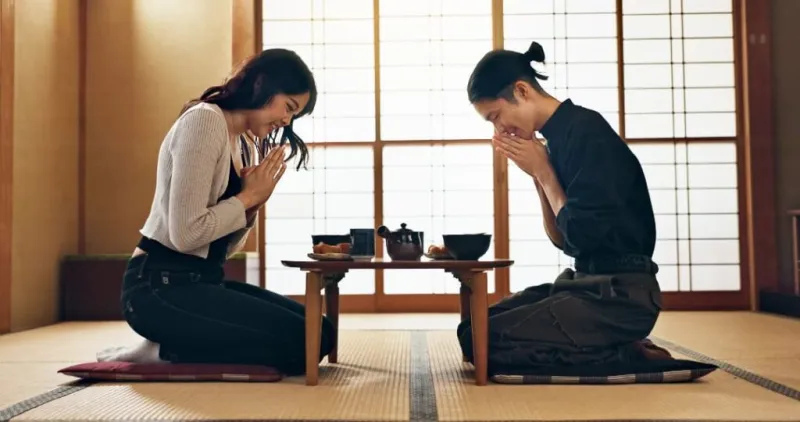
Timing should be simple. On arrival, after the first greetings and before settling into the room, the guest may offer the parcel with both hands, a slight bow, and a few plain words. Something like ‘A small thing for the household’ is enough. Excessive apology — ‘It is nothing, I am sorry it is so poor’ — can make the host uneasy, while excessive praise of one’s own gift reverses the intended humility. The middle path is brief and sincere.
The host may set the gift aside without opening it. This is not a slight. In a tea gathering, the order of the room has its own pace, and the parcel can wait. If the host chooses to open it, the guest should accept the attention without directing it. If the host asks where it came from, a short answer is sufficient; a long account of the producer, the journey, or the price is rarely necessary and can tip consideration into display.
The Question of Return
A gift should not make the host feel indebted. This is the heart of the matter. Avoid bringing something so costly or so rare that the host must begin to think of a return. Avoid mentioning effort, expense, or difficulty in obtaining the item. The guest’s labour is not the point; the host’s ease is. If the host offers something in return — a small sweet, a packet of tea, a lift to the station — accept it without protest. Refusing a return can be as awkward as demanding one.
In Birmingham, where many tea gatherings are small and domestic, the most fitting gifts are often the least dramatic: a jar of local honey, a neat packet of roasted tea for the winter, a box of plain sweets that will keep. They say that the guest has considered the household without trying to furnish it. That is a modest ambition, and a sufficient one.
A Small Discipline
The gift at the gate is not a test of knowledge about Japan, nor a competition in taste. It is a practical expression of the same attention that governs the rest of the visit: arriving on time, removing wet shoes considerately, listening more than speaking, and leaving the room as one found it. A parcel chosen with that spirit need not be Japanese, expensive, or elaborate. It need only be offered with a quiet hand and received without obligation.