The Considerate Departure: Closing a Tea Gathering with Grace in Birmingham
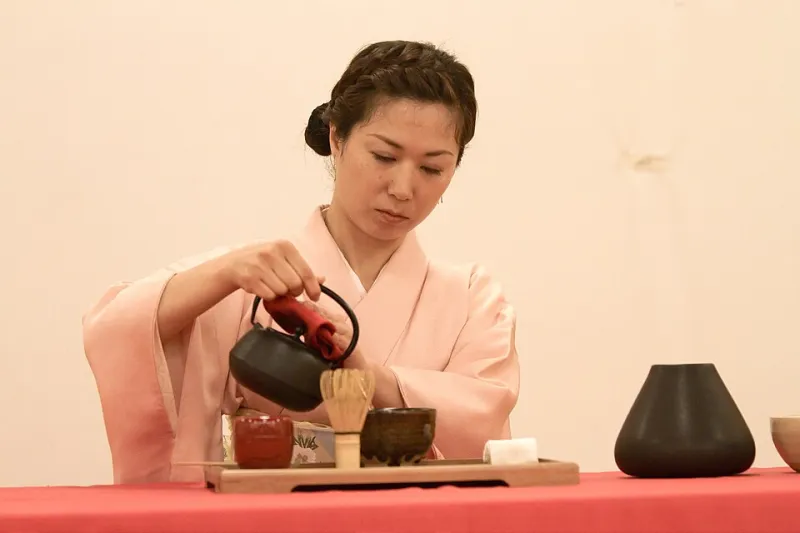
Photo: Georges Seguin (Okki), CC BY-SA 3.0, via Wikimedia Commons
A tea gathering does not end when the last drop is taken. The closing minutes carry their own weight, and how a guest leaves can linger in the memory quite as much as the tea itself. In the Urasenke tradition, departure is not a hurried exit but a final act of consideration. For guests in Birmingham, where gatherings often take place in shared halls, community rooms, and public tea spaces, that consideration must also account for buses, dark afternoons, and the needs of those who will use the room next.
Admiring and Returning the Bowl
When the tea has been finished, the bowl should be admired before it is returned. Hold it gently, turn it so that the front faces you, and take a moment to look at the glaze, the shape, and the marks left by the whisk. This is not performance; it is a quiet expression of gratitude to the vessel and to the host who chose it. In a formal setting, the bowl is then wiped at the rim with a folded cloth—usually provided—and returned to the host or placed on the tray as directed.
In less formal gatherings, the same principle applies without rigid ceremony. Do not stack the bowl with other items or push it away. Place it back where it came from, or hand it to the host with both hands if that is the custom of the room. If you are unsure, watch the host's example and follow it. The aim is to leave the bowl as you found it: cared for, not abandoned.
Thanking the Host Without Fuss
A simple, sincere thank-you is sufficient. There is no need for elaborate speeches or repeated expressions of gratitude. In Japanese tea practice, a bow and a few well-chosen words carry more weight than effusive praise. In a Birmingham tea room or community hall, the same restraint is welcome. Thank the host for the tea, for the time, and perhaps for a particular detail—the sweetness of the wagashi, the warmth of the room, the care taken in preparing the bowl.
Avoid lingering in the doorway with prolonged goodbyes, which can hold up other guests or the host's own departure. If you wish to offer a small token—a box of sweets, a packet of tea—do so quietly and without expecting it to be opened or discussed at length. The host may be managing the room, washing utensils, or preparing to lock up; your thanks should add to the calm, not delay it.
Tidying Your Place
Before you rise, look at the space around you. In a shared venue, this matters especially. Fold any cloth or paper you have used, place your chopsticks or sweet pick on the rest as instructed, and ensure that no crumbs or spills are left behind. If you have borrowed a cushion or a floor seat, return it to its place. If you have been given a tray, leave it tidy rather than stacked with unrelated items.
In many Birmingham halls, the host will have a clear routine for clearing away. Offer to help only if it is appropriate; in formal tea, guests do not usually wash utensils, but in a community setting a quiet offer to carry a tray may be welcome. Read the room. The guiding principle is to leave the space as you would wish to find it—ready for the next person, whether that is another guest or the caretaker who will lock the doors.
Judging the Right Moment to Leave
The end of a tea gathering is often signalled by the host's movements: the clearing of the bowl, the folding of the cloth, the final words of thanks. Do not wait for a formal dismissal, but do not rush away before the host has had a chance to close the gathering properly. In a public venue, the host may need to pack away equipment; in a private home, they may wish to offer a final cup or a few minutes of conversation.
A useful rule is to leave when the tea things have been cleared and the host has thanked the guests. If you must depart early—because of a train, a bus, or a caring responsibility—tell the host quietly at the start or during the gathering, not in the final minutes. This allows them to adjust the pace and to say goodbye without disruption. In Birmingham, where November afternoons darken early, it is sensible to check the time and the route home before the gathering begins, so that your departure is calm rather than rushed.
Birmingham Notes: Transport, Darkness, and Shared Rooms
Birmingham's tea gatherings are often held in venues that are not the host's own home: community centres, church halls, rented rooms above shops. This brings practical obligations. Check whether the room needs to be cleared by a certain time, and whether chairs must be stacked or tables wiped. If you are travelling by bus or the West Midlands Metro, allow for the walk to the stop and the possibility of a wait in the cold. In winter, carry a small torch or use your phone's light for unlit paths, and keep your coat and bag close so that you are not searching for them in a dark corridor.
If you have come with others, agree beforehand whether you will leave together or separately, so that no one is left waiting uncertainly. And if you are the last to leave, offer to help the host with the final check of the room—windows, lights, doors—not as a grand gesture but as a natural extension of the care that began when you arrived.
Leaving well is not about perfect form. It is about attention: to the bowl, to the host, to the room, and to the journey home. In Birmingham, that attention is a form of respect that travels well beyond the tea room.